

The dream of working remotely from an exotic location often brings to mind the vibrant landscapes and rich cultures of Asia. But beyond the stunning photos, finding a place to genuinely call home as a digital nomad requires navigating a maze of practicalities: visas, costs, community, and daily logistics.
For many, the biggest hurdles aren’t the work itself, but figuring out where you can realistically stay long-term and how to manage the essentials of daily life while balancing work and well-being. This article cuts through the romance to provide a direct, actionable look at five Asian cities that consistently rank high for their blend of affordability, infrastructure, community, and lifestyle, helping you make an informed choice grounded in reality.
Visas and Legal Stay in Asia
The primary challenge for digital nomads in Asia is securing legal long-term residency without local employment, as most countries lack dedicated “digital nomad visas” (though this is slowly changing).
Consequently, many rely on tourist visas (typically 30-90 days), potentially using “visa runs” (exiting and re-entering) or exploring complex business/education visas – options often unsuitable for remote work and highly dependent on nationality and specific country rules (always check official immigration websites).
Relying solely on tourist visas or frequent visa runs is inherently risky and disruptive, requiring careful planning and flexibility. Some countries, like Malaysia (DE Rantau Nomad Pass) and Thailand (Long-Term Visa – LTV), are now introducing specific solutions, making understanding these nuances essential.
Cost of Living
Asia is renowned for offering a significantly lower cost of living compared to North America or Europe, but this varies dramatically from city to city. For digital nomads, understanding where your money goes furthest without sacrificing essential comforts is key. We’ll look at typical costs in our five chosen cities:
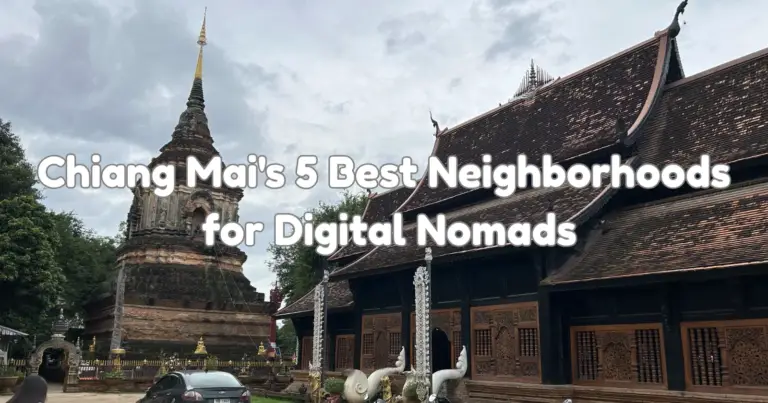
Chiang Mai, Thailand: Often cited as a foundational nomad hub. It offers perhaps the lowest cost of living among the top contenders. You can find decent one-bedroom apartments outside the city center for $300-$500 USD per month. Food, especially delicious Thai street food, is incredibly cheap, often just a few dollars per meal. Transport (scooters or ride-sharing apps like Grab) is affordable. A comfortable lifestyle here can be achieved on $1000-$1500 USD per month.
Bali (primarily Ubud or Canggu), Indonesia: Bali offers a tropical paradise vibe with costs slightly higher than Chiang Mai. A one-bedroom villa or apartment typically ranges from $500-$1000+ USD/month depending on location and amenities. While local food (Warungs) is cheap, the cost of Western food, trendy cafes, and imported goods adds up. Transport often involves scooters or taxis/Grab. A realistic comfortable budget is $1200-$2000 USD per month.
Kuala Lumpur, Malaysia: As a major capital, KL is more expensive than Chiang Mai or Bali but offers excellent infrastructure. A modern one-bedroom apartment in a nice area might cost $500-$800+ USD/month. Food is diverse and affordable, from hawker stalls to mid-range restaurants. Public transport is efficient and reasonably priced. A comfortable budget is typically $1500-$2500 USD per month. Comparing KL to Chiang Mai shows KL is generally more expensive overall, particularly for rent.
Da Nang, Vietnam: A rapidly growing coastal city. Cost of living is very attractive. A one-bedroom apartment near the beach can be found for $350-$600 USD/month. Local food is incredibly cheap and delicious. Transport is mainly scooters or affordable taxis/Grab. You can live comfortably here on $1000-$1500 USD per month.
Taipei, Taiwan: Located in East Asia, Taipei is significantly more expensive than the Southeast Asian options but still offers value compared to major Western cities. Rent for a one-bedroom apartment might range from $700-$1200+ USD/month, depending on the district. Food costs are moderate, with plenty of affordable local options. Public transport is excellent and inexpensive. A comfortable budget is likely $1800-$3000+ USD per month. The Economist’s cost of living index often includes Taipei among moderately expensive global cities.
These are just estimates, and your actual costs will depend on your spending habits, but they provide a solid baseline for comparison.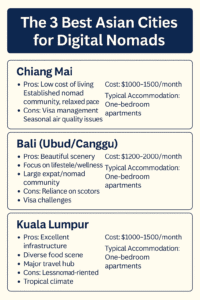
Infrastructure, Connectivity, and Finding Your Community
Work Infrastructure: Reliable internet is non-negotiable; major Asian cities generally offer excellent speeds, often surpassing the West. Affordable mobile data via easy-to-obtain local SIM cards (sometimes at airports) is widespread.
While power stability can vary (occasional outages possible outside major centers), it’s generally reliable in the cities discussed. Coworking spaces are prevalent, providing reliable internet, power backup, and a professional environment, typically costing $100-$250 USD per month.
Community & Well-being: Finding community is crucial to prevent isolation. All five cities have established digital nomad/expat communities, though they vary:
- Chiang Mai & Bali: The most mature hubs, with countless meetups, events, and active Facebook groups.
- Kuala Lumpur & Da Nang: Have active, though potentially smaller, nomad scenes.
- Taipei: Has a strong expat community; its nomad-specific scene might be less prominent than in Southeast Asia, but the city’s safety and ease of navigation facilitate connections. Engaging in local activities (yoga in Bali, language exchanges in Taipei, cooking classes in Chiang Mai) is a great way to build relationships beyond the nomad circle.
Practical Setup:
Banking: Setting up local banking can be challenging without a long-term visa/address. Alternatives include international digital banks or opening accounts in countries with more favorable policies for longer stays.
Transport: Generally easy. Ride-sharing apps like Grab dominate in Southeast Asia and Taiwan (Uber exists in some places). Taipei boasts an exceptionally clean and efficient MRT system.
City Spotlights: Why These Five?
Each of these cities offers a unique blend of factors making them attractive digital nomad bases:
Chiang Mai, Thailand: Pros: Low cost of living, large and established nomad community, excellent cafes and coworking spaces, relaxed pace, access to nature. Cons: Can feel somewhat isolated from other parts of Thailand/Asia if you don’t fly, air quality issues during burning season (typically Feb-Apr).
Bali, Indonesia: Pros: Beautiful scenery, strong focus on wellness and lifestyle, vibrant spiritual community, many villa options with pools, large expat/nomad community. Cons: Can be more expensive than other SE Asian options, heavy reliance on scooters for transport (traffic can be bad), visa situation (B211A visa is common but often requires an agent, adding cost and complexity), can feel like a “bubble.”
Kuala Lumpur, Malaysia: Pros: Excellent infrastructure (internet, transport), affordable modern apartments, diverse food scene, major travel hub with easy access to the rest of Asia, cosmopolitan feel. Cons: Less traditional “nomad vibe” than Chiang Mai/Bali (more expats than transient nomads), tropical climate can be very hot/humid, certain areas lack walkability, visa options require research (DE Rantau or other workarounds).
Da Nang, Vietnam: Pros: Very low cost of living, beautiful long beach, developing infrastructure, friendly locals, delicious and cheap food, growing nomad scene, proximity to Hoi An. Cons: Nomad community is smaller and newer than Chiang Mai/Bali, less diverse international dining/shopping compared to larger cities, internet can be less stable than in capital cities, visa rules can change.
Taipei, Taiwan: Pros: Extremely safe, excellent public transport, high-quality infrastructure (internet, healthcare), vibrant modern culture with traditional roots, friendly locals, diverse food scene, relatively stable visa policy compared to some SE Asian countries. Cons: Higher cost of living than SE Asia, smaller dedicated digital nomad community (more traditional expats), language barrier can be more pronounced outside tourist areas, humidity in summer.
Choosing the “best” city depends entirely on your personal priorities: budget, desired lifestyle, importance of a large nomad community, preferred climate, and tolerance for visa hurdles. Consider which city aligns best with your workflow and work-life balance goals.
“The world is a book, and those who do not travel read only one page.”
Embarking on the digital nomad lifestyle in Asia is indeed like opening a new chapter. It requires diligence and preparedness, not just wanderlust.
Making it Happen: Actionable Steps and Resources
Deciding on a city is just the start. To make your move as smooth as possible:
- Research Visas Thoroughly: Check the official immigration websites of your target countries for your specific nationality just before you plan to travel, as rules can change without much notice. Do not rely on outdated blog posts.
- Plan Your Budget: Use sites like Numbeo or search for recent nomad cost of living reports for your chosen city. Add a buffer for unexpected expenses.
- Book Initial Accommodation: Secure at least your first week or two through platforms like Agoda (popular in Asia), Booking.com, or Airbnb while you scout longer-term rentals.
- Join Online Communities: Search for “[City Name] Digital Nomads” or “[City Name] Expats” on Facebook. These groups are invaluable resources for asking questions about everything from visas and accommodation to finding social events.
- Prepare for Connectivity: Ensure your phone is unlocked before you arrive so you can easily buy a local SIM card upon arrival. Research local mobile carriers.
Asia offers incredible opportunities for digital nomads seeking adventure, cultural immersion, and often, a lower cost of living. The cities listed here provide varying balances of these factors, coupled with essential infrastructure and community. However, remember that the lifestyle requires proactive management of practicalities, especially regarding legal stay. By approaching it with realistic expectations and solid preparation, you can build a fulfilling remote life in one of these fantastic Asian cities.