


Long before I ever visited, I was captivated by images of Hashima Island. Known as “Gunkanjima” (Battleship Island), it looked like something out of a movie – a ghost city of concrete towers abandoned to the sea. Visiting in person was even more powerful than I imagined.
You can almost feel the history in the air, a silent echo of the thousands of people who once called this tiny rock home.
A trip to Hashima is one of the most unique things you can do in Japan, but planning it can feel a bit tricky. This guide makes it simple. I’ll break down exactly how to book your tour, what to expect on the day, and the fascinating story of why this city was abandoned, helping you plan your own unforgettable trip.
Hashima Island at a Glance: Your Quick Guide
Before we dive in, here are the essential facts you need to know.
| Feature | Details |
|---|---|
| 📍 Location | Approx. 40-50 minute boat ride from Nagasaki Port. |
| ⏱️ Duration | Approx. 3 hours for the entire round-trip tour. |
| 💰 Cost | ¥4,500 + ¥310 per person (tour + landing fee for adults). |
| ⚠️ Key Challenge | Landing on the island is highly weather-dependent and can be canceled at the last minute due to rough seas (wave heights exceed 0.5 meters) or low vision around the island – which happens frequently. The landing fee and 10% of the tour fee will be returned by the operator in case if they can’t effect a landing. |
How to Book Your Hashima Island Tour: A Step-by-Step Guide
Visiting Hashima is only possible via a licensed tour boat. You cannot go on your own. Booking is straightforward if you follow these steps.
- Choose Your Tour Operator: The best known, oldest, and most reputable company operating out of Nagasaki Port is Yamasa Shipping Co. Ltd. The company operates two websites, The Gunkanjima Cruise and Yamasa Shipping, which may give the impression that they are two different providers. However, both websites actually lead to the same tour booking page.
- Book Online in Advance: This is crucial. Tours, especially on weekends, national holidays, or during peak travel seasons, sell out weeks in advance. Booking online (respectively making a reservation) is the only way to guarantee your spot and sometimes comes with a small discount.
- Get to Nagasaki Port Terminal (Ohato): This is where all the main tours depart. Getting there is easy: take the Tram Line 1 (the blue line) from Nagasaki Station to the “Ohato” stop. The terminal is a well-signed, 2-minute walk from there.
- Check-in and Pay: You must arrive at the terminal at least 30 minutes before your scheduled departure. Go to your tour company’s designated ticket window on the 1st floor to present your booking confirmation and pay.
- Confirm Payment Method: This is a top tip: All operators are still cash-only at the counter. Check your booking confirmation carefully and bring enough Japanese Yen to cover the fare to avoid any last-minute panic.
- Sign the Landing Agreement: Because of the nature of the ruins, you will be required to sign a safety agreement acknowledging the rules and potential risks before you can receive your ticket. This is the reasn why the tour operators want you to appear early.
Know Before You Go: An Essential Checklist

- ✅ Book Ahead, Especially for Weekends: Don’t expect to walk up and buy a ticket on the day. Simply make a reservation online here.
- 🌦️ Have a Backup Plan: Your tour can be completely canceled due to high waves, even on a sunny day. If landing is impossible (in some months, landing is not possible on more than half of the days), the tours will proceed as a cruise around the island (with a refund of the landing fee and a 10% refund of the tour price). Have a rainy-day Nagasaki activity in mind just in case.
- 💰 Bring Cash for Payment: Double-check if your operator is cash-only. Don’t get caught out.
- 👟 Wear Closed-Toe Shoes: This is a requirement for landing. The terrain is uneven. No sandals or high heels.
- ⚠️ Check for Mobility Issues: The tour involves stairs (around 30 steps) and uneven surfaces. It is unfortunately not barrier-free or wheelchair accessible.
- 🎒 What to Bring: Sunscreen, a hat, and water are essential. A light jacket is also recommended, as it gets very windy (and cold) on the boat deck.
🤢 Prone to Seasickness? The journey can be choppy. Take motion sickness medication before you board and try to sit in the middle of the boat. The nearest drug store to the ferry port is in the first basement of the Youme Town Yumesaito shopping center.
The Experience: What to Expect on the Day

The Journey Out
As the boat leaves Nagasaki Harbor, the city skyline, framed by green hills, slowly disappears from view. The 40- to 50-minute trip to the island is an experience in itself, passing the huge Mitsubishi shipyards, which are central to Nagasaki’s industrial history. In addition, several Japanese Navy warships and coast guard vessels can be seen on the way out of the harbor.
First Sight
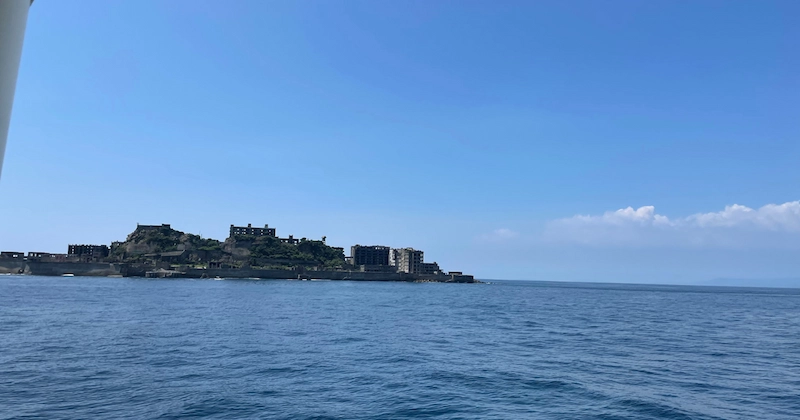
Then it appears on the horizon. A low, gray silhouette that really looks like a battleship. The closer you get, the clearer the details become: a dense cluster of concrete apartment blocks, derricks, and dikes, all crammed onto a tiny rock in the middle of the sea. The boat usually circles the island first, offering you incredible photo opportunities and allowing the tour guide to point out important buildings such as the school, the hospital, and the infamous “Stairway to Hell.”
Stepping Ashore
When the sea is calm enough to dock, you disembark at a specially constructed pier. You cannot move freely around the ruins, as they are too dangerous. Instead, you are led to three fenced-off viewing platforms. From these vantage points, you will be close enough to feel the overwhelming size of the place. You will look into the empty windows of Block 65, once Japan’s largest concrete building, and see the abandoned schoolyard, where weeds now grow through the cracked asphalt. The tour of the island lasts just under an hour before returning to the ship.
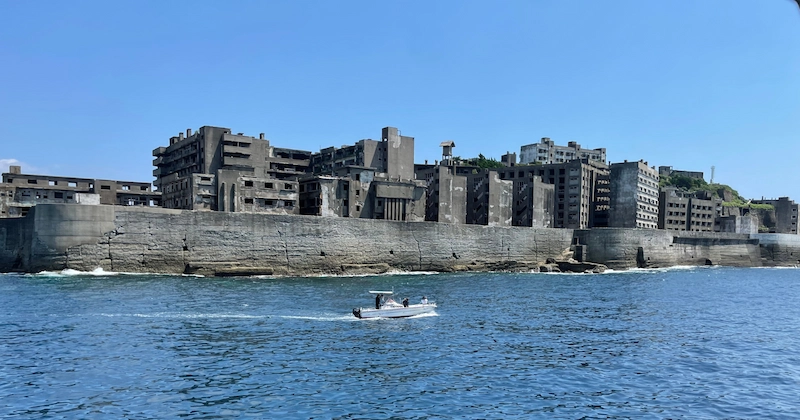
What surprised me most was the silence, broken only by the cries of seagulls and the sound of waves. It’s one thing to read that over 5,200 people once lived here, but quite another to stand there and try to comprehend that population density. The contrast, once the most densely populated place on earth, now completely silent, is deeply moving.
The Story of Hashima Island (Gunkanjima)
- The Rise (1890-1959): Mitsubishi purchased the island to mine rich undersea coal seams. To house the workers and their families, they built a fortress city, including Japan’s first high-rise concrete apartments, designed to withstand brutal typhoons. The population swelled to over 5,000 people, creating a self-contained city with schools, shops, a cinema, and a hospital.
- The Fall (1960s-1974): The energy landscape shifted as Japan moved from coal to oil. The mine became unprofitable. In 1974, it was abruptly closed, and all residents were evacuated within a matter of weeks, leaving everything behind.
- The Rebirth (2009-Present): After decades of being battered by nature, tours were finally allowed to land on a small, stabilized portion of the island. In 2015, it was recognized as part of a UNESCO World Heritage site celebrating Japan’s Meiji Industrial Revolution.
- The Contested History: It is vital to acknowledge the darkest chapter of the island’s story. During World War II, many Korean and Chinese civilians were forced to work here and in other Japanese mines under brutal, inhumane conditions. This painful legacy is a crucial part of the island’s history that must be remembered and respected during any visit.
Is the Hashima Island Tour Worth It?

So, is this complicated, weather-dependent, and somber trip worth your time and money? For most travelers, the answer is an emphatic yes.
Go to Hashima if: You are fascinated by industrial history, unique architecture, urban exploration (urbex), or photography. The sheer scale of the abandoned city and its powerful story are unforgettable.
You might want to skip it if: You are on a very tight schedule (due to the risk of cancellation), have mobility issues, or are highly prone to severe seasickness.
Ultimately, Hashima is not a “fun” day trip, but it is a profoundly memorable one. It’s a powerful lesson in human ambition, the rise and fall of industry, and the haunting beauty of decay. It’s an experience that will stick with you long after you’ve returned to the vibrant, living city of Nagasaki.