


If you’re reading this, you’re probably looking for more than just a vacation. You’re looking for a reset. I get it, because I was too. My search for a meaningful wellness experience led me to Bali, and it delivered more than I could have imagined. Beyond the stunning beaches and rice fields, I found a culture where harmony and well-being are part of the daily rhythm.
In this 10-day itinerary, I’m sharing the exact path I took to find balance on the island. This is a curated journey through the places and practices that had the biggest impact on me. From my first traditional Balinese massage that melted away weeks of stress to a powerful water purification ceremony, I’m including my personal notes and tips to help you experience the island’s healing energy with respect and an open heart.
The Origins and Philosophy of Balinese Wellness
First, let me provide you some background on the origins of Wellness in Bali. The Balinese culture is deeply rooted in Agama Hindu Dharma, a local adaptation of Hinduism blended with animism, Buddhism, and ancestral worship. This unique spiritual foundation underpins every aspect of life, including their approach to health and harmony. A central philosophical tenet is Tri Hita Karana, meaning “three causes of well-being” or “three reasons for prosperity.” This principle emphasizes the importance of maintaining harmonious relationships:
1. Prajapati: Harmony between humans and God (or the spiritual realm). This is expressed through rituals, offerings, and devotion at temples.
2. Pawongan: Harmony between humans and other humans. This involves community cooperation (gotong royong), social rituals, and maintaining respectful relationships.
3. Palemahan: Harmony between humans and nature/environment. This is evident in the careful management of land, the reverence for natural elements, and agricultural practices like the subak (traditional irrigation system).
The concept of Tri Hita Karana suggests that true well-being arises from balancing these three interconnected realms. Illness or misfortune is often traditionally understood as a disruption of this harmony, requiring ritual or traditional healing to restore balance.
Complementing this is the understanding of the sekala (visible, physical world) and niskala (invisible, spiritual world). Balinese practices often seek to harmonize these two realms, recognizing that unseen forces, energies, and spiritual states profoundly impact physical and mental well-being. Traditional Balinese healing, known as Usada, operates within this framework. Usada texts, often written on lontar palm leaves, contain knowledge passed down through generations of Balian (traditional healers). This knowledge encompasses herbal remedies, massage techniques, energy work, and spiritual rituals, all aimed at restoring balance between the physical, mental, and spiritual aspects of a person, and their relationship with the wider universe.
“In Bali, when you are sick, you do not go to the doctor for just one simple reason. We believe that every sickness comes from the disharmony between your body, mind, and spirit.”
– Cokorda Rai, Balinese Healer
My 10-Day Journey to Inner Balance (for you)
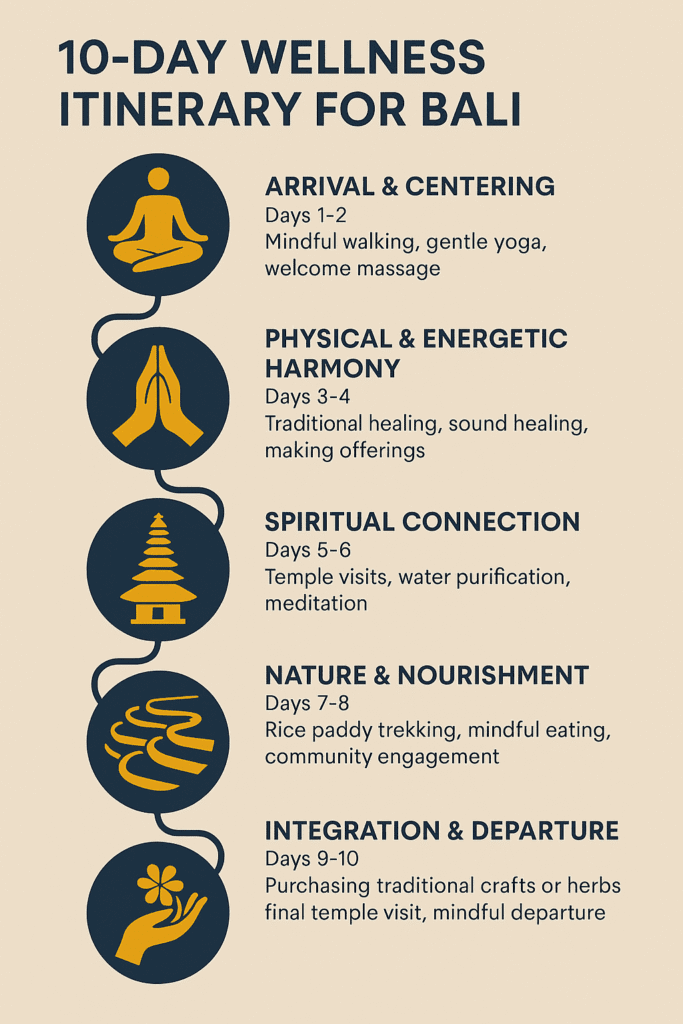
Days 1-2: Arrival and Gentle Centering in Ubud |
Focus: Acclimatize to the island’s rhythm and gently release travel tension. Ubud, the spiritual heart of Bali, is the perfect place to begin, trading chaotic streets for the calming sounds of the jungle.
|
Days 3-4: Physical and Energetic Harmony |
Focus: Delve deeper into Bali’s traditional healing arts that target both the physical (sekala) and energetic (niskala) bodies.
|
Days 5-6: Spiritual Connection and Purification |
Focus: Engage with Bali’s deep spiritual traditions through sacred water rituals and a respectful encounter with a traditional healer.
|
Days 7-8: Nature, Nourishment, and Community |
Focus: Reconnect with the earth by exploring Bali’s stunning landscapes and understanding the community’s deep bond with nature.
|
Days 9-10: Integration and Mindful Departure |
Focus: Transition to the vibrant coast to integrate your experiences with the calming, expansive energy of the ocean before you depart.
|
Practical Tips for Your Bali Wellness Journey
To make your trip seamless, here are a few essential tips based on my experience:
- Getting Around: Renting a scooter is popular but only recommended for experienced riders. For stress-free travel, use ride-sharing apps like Gojek or Grab, or hire a private driver for day trips (approx. 600,000 – 800,000 IDR for 8-10 hours). Trust me on this, download the Gojek app before you even land. It became my lifeline. I learned the hard way that local taxis can be expensive, but a Gojek bike ride across Ubud is cheap, fast, and an experience in itself! For day trips, hiring a driver like my go-to guy, Wayan
- What to Pack: Light, breathable clothing, modest attire for temple visits (a sarong and sash, which are often available for rent), reef-safe sunscreen, insect repellent, and a reusable water bottle to stay hydrated.
- Budgeting: Wellness activities can range from affordable to luxury. A massage can be $15, while a full-day retreat might be $150+. Plan for an average of $50-$100 per day for activities and healthy meals. Many high-end retreats can cost over $2,500 for a week.
- Etiquette: When visiting a Balian healer or a temple, always dress modestly and act with respect. Never point your feet at a sacred object or a person, and don’t touch anyone’s head. A small donation is often expected.
A Deeper Dive: Etiquette for Sacred & Healing Spaces
Engaging with Bali’s spiritual practices is a privilege. To ensure your experience is respectful and meaningful, it’s crucial to understand the cultural nuances. This is about appreciation, not appropriation.
- On Visiting a Balian (Healer): This is not a transaction; it’s a sacred consultation. Do not haggle. Dress as you would for a temple (shoulders and knees covered). Present a canang sari (small offering) which you can purchase locally, and provide a donation (dana) in an envelope at the end. Be present, listen more than you speak, and manage your expectations—healing is a journey, not a quick fix.
- On the Melukat Ceremony: Remember you are entering an active place of worship.
- Do not use soap or shampoo in the holy springs.
- Women who are menstruating are respectfully asked not to enter the temple or the water, a local custom related to sacred purity.
- Wear the required wet sarong and sash; do not wear swimwear alone. It’s respectful to wear a T-shirt underneath.
- Move through the ritual with intention and quiet reverence. Avoid loud conversations and be mindful of local devotees who are there to pray.
- General Temple Etiquette: Always cover your shoulders and knees with a sarong and sash. Do not point your feet at altars, and never sit higher than a priest or offerings. Your respectful presence will be warmly welcomed.
My Reflective Conclusion
Before my first wellness trip to Bali, I thought ‘finding balance’ meant doing everything perfectly—the yoga, the diet, the meditation. I was wrong. What I actually discovered was that balance is about listening to what you truly need in the moment.
So, please, use this guide as a starting point, not a strict rulebook. If you feel like skipping a planned trek to sit and watch the rice paddies for an extra hour, that might be the most ‘wellness’ thing you do all day. I learned more from a spontaneous chat with my guesthouse owner than I did in some workshops. The goal isn’t to ‘complete’ this itinerary in 10 days; it’s to let Bali begin something new in you, something you can carry back into your daily life.
Frequently Asked Questions (FAQ) for Your Bali Wellness Trip
What is the best time of year for a wellness trip to Bali?
The best time is during the dry season, from April to October. You’ll experience less rain, lower humidity, and plenty of sunshine, making it ideal for yoga, trekking, and beach relaxation. However, this is also the peak tourist season. For a quieter experience with lush green landscapes, consider the shoulder months of April, May, and October.
Is Bali safe for solo female travelers?
Yes, Bali is widely considered a very safe and welcoming destination for solo female travelers. The wellness community, especially in areas like Ubud and Canggu, is incredibly open and easy to connect with. Standard safety precautions should still be taken: be mindful of your belongings, avoid walking alone in isolated areas late at night, and be cautious if renting a scooter for the first time.
What should I pack specifically for a wellness-focused trip?
Beyond your usual travel clothes, prioritize these items:
- Breathable Activewear: At least 3-4 sets of yoga pants/shorts and tops. Quick-dry fabric is essential in the humidity.
- Modest Temple Attire: A lightweight long-sleeved top and loose pants or a long skirt, in addition to the required sarong and sash. A shawl is very versatile.
- Wellness Toolkit: A journal and pen for reflection, your favorite essential oils, electrolyte packets to combat dehydration, and a good probiotic to support gut health.
- Reusable Water Bottle: Essential for staying hydrated and reducing plastic waste. Many cafes and hotels offer free refill stations.
- Reef-Safe Sunscreen & Natural Bug Repellent: Protect your skin and the environment.
Do I need to be an expert yogi to enjoy this itinerary?
Absolutely not! This itinerary is designed for all levels. Bali’s wellness scene is incredibly inclusive. Every studio offers beginner-friendly classes, and the focus is less on advanced postures and more on the mindful connection between breath, body, and spirit. The true “work” is about showing up for yourself with an open mind.